If you have found yourself here, it is probably because you are interested in manufacturing services focused on custom molded plastics. Well, congratulations! You have come to the right place. GPI has been an expert in custom plastics manufacturing for nearly 50 years and we can’t wait to share what we have learned. A few months ago, GPI posted its article: Top Ten Things To Know About Manufacturing With Plastics. We will use this as a rough syllabus for Plastics 101, so let’s start at the top with item #1 …
Injection Molding
Injection molding is exactly what it sounds like. It involves the process of melting a solid material, injecting it into a mold, and then letting it cool down and harden back into a solid. This process allows for a great deal of flexibility with color, clarity, special effects, shape, hardness & softness, etc.
Here’s a picture of what our molds look like when they’re not in use:

How Does It Work?
The first step in the Injection Molding process is to make the mold. Using your 3D file, we quickly convert it to a format that can be read by a CNC machine. Because our employees are superstars, we can often accomplish this from a flat 2D vector image as well, but 3D is vastly preferred. The CNC machine will eventually take that data and cut your mold from steel, which allows you to make your products over and over again. We give customers the opportunity to check a proof file and make any necessary modifications before we proceed to make the mold.
Cutting the mold is a lengthy process that takes anywhere from 30 to 45 days, depending on the complexity of your mold. A timeline you should use for your production planning. Products that require multiple molds or extra complex molds can take longer. Once the mold is finished, GPI produces tooling samples for our customers. This allows you the opportunity to see what your finished product will look like in your desired colors for quality assurance. We use Pantone colors to precisely match your desired look, which differs from our printing production process, which depends on CMYK artwork.
Once the tooling samples are approved, we will get your mold on the Injection Machines. Injection molding machines are massive pieces of equipment that allow raw materials to be melted down, pushed through into the mold cavities by massive screws, then cured in the mold before the sprue is pulled from the cavity and either removed whole or with individual pieces cut away. The last two steps of the process involve cooling, which allows the liquified raw material to solidify into your finished product. Once the product is done, it can be tumbled and polished to clean up any surface imperfections, like flow marks or extra plastic, stuck to the injection gate.
But what can we actually manufacture with Injection Molding?
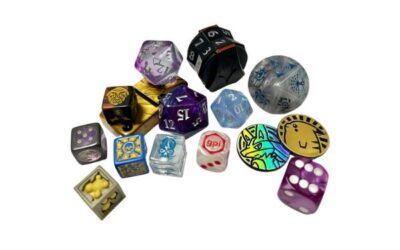
The possibilities are almost endless as is the variety of types of plastics we use! Injection Molded Acrylic is very commonly used to produce dice and can be matched to almost any Pantone color, including beautiful translucent gem-like finished products or with embedded glitter. Softer plastics like Polypropylene (PP) are a great option for miniatures because its flexibility allows them to bend without breaking while still able to yield a highly detailed final product. Polystyrene (PS) can be brittle so we prefer to use High Impact Polystyrene (HIPS), which is more resistant to breaking and very effective for simple designs. ABS is a great plastic for general use. Polyoxymethylene (POM) is an ultra-strong, wear-resistant, and low-friction plastic, and as a result, is great for mechanisms.
Injection molding is also the process used to make finished products from super soft plastics and rubbers like Polyurethane (PU) foam or Thermoplastic Rubbers (TPR) and even Silicone (LSR). These materials are used in everything from stress balls, toy manufacturing, cookware production, and even medical equipment. And this is only a small fraction of the variety of materials that can be used in Injection Molding. What other materials can you think of that you might want to use for Injection Molding?
If you have needs for injection-molded components or finished products, reach out to GPI through our contact form, and one of our talented staff members will help get you started. We cannot wait to be your manufacturing partner and keep your eyes peeled for Plastics 101: Lesson 2!